Vuo Fa L’Americano: Do you want to be an American?
I heard this song on the radio in my car the other day. Catchy, no?
Here’s the original by Renato Carosene, from 1946:
The song is written in Neapolitan dialect and it’s about an Italian boy pretending to be an American by smoking Camels, watching baseball, and drinking whiskey and soda. The song is a reaction to the process of Americanization that took place in Italy after World War II, and the way that Italians glorified American culture.
Here’s a rough translation of the lyrics.
COUNTDOWN: 11 days until I leave for Italy
It’s getting closer and closer…
A scene from Piazza della Repubblica in Florence:

More about Nutmeg, part II
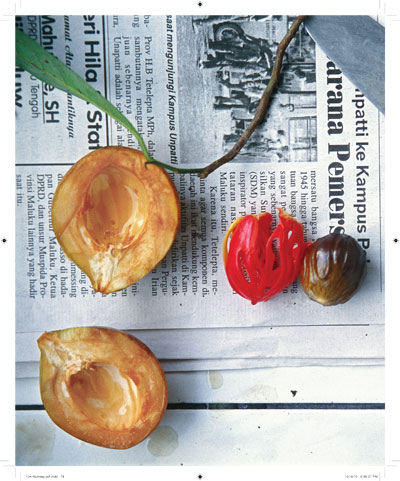
I’m not the only one who thinks nutmeg is awesome.
There’s my friend Dallas, for one. She bought balls of nutmeg to grate fresh into her food. Then there’s my German friend Angelina, who commented on my last nutmeg post just a few weeks ago. She says that she often adds it to savory and sweet dishes, and we concluded that it must be a European thing.
Then, thanks to Lindsay Hunt,my classmate at the French Culinary Institute and author of Lindsay Cooks, I found this article in Saveur: Cooking with Nutmeg: Sweetness and Light. It’s written by the great Beth Kracklauer, and it’s a fantastic introduction to the perplexing and pleasing contradictions of nutmeg.
She writes,
I realized I’d been eating nutmeg in cheesy, eggy, and creamy dishes all my life; it was both familiar and a total mystery to me….It can overwhelm if used in excess, but nutmeg has a remarkable capacity to enhance other flavors…. While its flavor blooms in buttery sweets, the spice also thrives in savory foods. In Italy, nutmeg is used to take the metallic edge off of leafy greens, in dishes like the ricotta-and-spinach dumplings called malfatti.
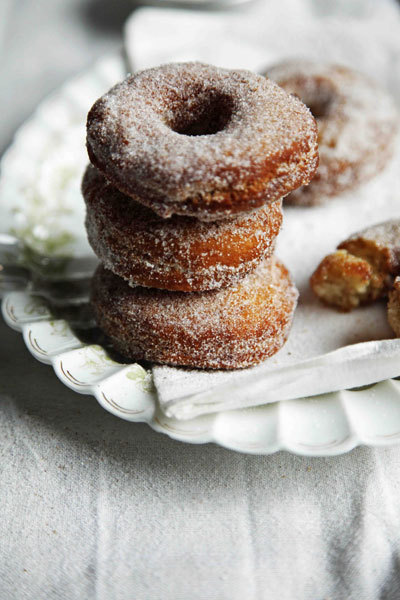
Check out the article to find out more about nutmeg’s illustrious history. Looks like the article includes some great recipes, including one for Nutmeg Donuts and one for Nutmeg Ice Cream.

Banned Italian TV Commercial
My friend Anthony, who blogs at Not Intent on Arriving, responded to my last post with a commercial suggestion of his own. This one was banned for being too suggestive:
Also check out his recent News In Italy post.
Lick Me!
Thanks to Dallas for the tip-off on this Italian TV commercial.
“Leccami,” as you may have guessed, means “lick me.”
Text at the end of the ad: “If you don’t lick your finger, you only enjoy it half-way.”
ITALY IN BOOKS: 2011 Reading Challenge
I was just surfing Twitter tonight when I came across a new blog: Book After Book.
Blogger Silvia M. is proposing a challenge to read 12 books in 2011 that take place in Italy (not necessarily written in Italian or by an Italian.) I’m in. And I already know what my first title will be: Corelli’s Mandolin, one of my all-time favorites (I hope re-reads are allowed.)
I’ll be blogging about all my selections here.
Rule #5: How to drink coffee
Like many Americans, I am addicted to coffee. But this post isn’t about me and my addiction, which predates my obsession with Italy. It’s about coffee culture in Italy.
This is Rule #5: How to drink coffee. As such, reflecting the intricacies of its subject, it contains a several by-laws.
Sub-Rule 5.i: Never drink lattes after lunch (or after dinner.) Latte and cappuccino–any combination of coffee and a significant amount of hot milk–is intended for breakfast only, to be consumed on an empty stomach. The substance of the milk combined with the caffeine in the coffee gets you out of bed and into the fresh air. If you’re lucky, the barista will make you a little design in your foam:

Sub-Rule 5.ii: You can’t find American-style drip coffee in Italy. Don’t even try. If you’re desperate, you can order an Americano, just like at Starbucks. Except in Italy, they brew the espresso into a larger mug, and give you a little pitcher of hot water to pour in yourself.
Sub-Rule 5.iii: There are no Starbucks in Italy. (Even though Starbucks is inspired by Italian cafe culture.) But there is a bar (translation: coffee shop) on every corner of every street in every city, usually advertised with a convenient sign that you can see from down the street.
Sub-Rule 5.iv: You don’t drink coffee (or soda, or water, or anything else) while you are doing something else. You don’t have a giant coffee mug from last year’s vacation at your desk. You don’t carry a cute travel mug as you walk the streets on a cold day .
Sub-Rule 5.v: But the good news is that, although you have to disconnect from the American-style caffeine IV, you still get to caffeinate. An espresso break is like a smoke break in Italy: leave your place of employment, walk down the street, order a shot of espresso (“un caffe, per piacere”) for about 50 euro-cents, lean against the bar like the sexy beast you are, and walk back across the street to work. Rinse and repeat as many times per day as necessary.
Sub-Rule 5.vi: After a meal (after dessert and after the fruit course), order an espresso. It will help you digest and avoid a post-meal slump.
Rule #4: Fare la bella figura
In my freshman year of college, I started Italian 101. I remember in the second or third week of classes, we were learning common expressions in the vocabulary section of our textbook. Underneath an illustration of a woman in tight jeans, designer sunglasses, and black leather boots were the words
Fare la bella figura.
I was perplexed. The phrase literally translates to “make a pretty figure.” Huh?
My professor explained that it’s very important for Italians to appear a certain way in public. This need affects the way they dress, the way they behave, the way they interact with other people.
I still didn’t get it. I didn’t get it until two years later, when I arrived in Italy and realized that after a few weeks, I was living it.
Let me give you a few examples.
- American Beth: wakes up, showers, runs out the door with wet hair dripping onto her shoulders. Italian Beth blow-dries her hair before leaving the house each morning.
- American Beth doesn’t wear makeup or perfume. Italian Beth does.
- American Beth carries a backpack. Italian Beth carries a purse.
- American Beth wears shorts. Italian Beth wears skirts.
- American Beth wears sneakers, flip-flops, or comfortable flats. Italian Beth wears Italian leather boots, even when she’s walking up a hill or exploring a new city all day long and getting blisters all over her toes.
I honestly did not consciously try to change myself to fit into a new country. It just rubbed off on me. It’s called La Dolce Vita for a reason, right?
I want to emphasize that fare la bella figura is not just about clothes. Even though the sentiment is often conveyed in English as “keeping up appearances,” the concept is by no means limited to only physical appearances. It encompasses social position as well, and modifiying your behavior in accordance with what looks good to others.
As I mentioned in my jogging post, Italian women usually don’t exercise outdoors because then their whole neighborhood will see them sweaty and without makeup. One thing that really interested me when I was in Italy was the elderly women who rode the bus line with me. They dressed to the hilt in furs, heels, pantyhose, and makeup, but without looking overdone or scary in the way that certain “well-preserved” older American celebrities look.
It occurs to me that Fare la bella figura might be compared to the American tradition of “keeping up with the Joneses.” Have the latest car, the latest iphone, the newest technology–I sense that this concept is more connected to being on the cutting edges, getting new things first. By contrast, fare la bella figura is adhering to well-established cultural wisdom, more or less the same values held generations ago.
The original Italian-American love affair
I fell in love with this scene from Fellini’s masterful La Dolce Vita when I was in Italy. Its breathtaking romance results from the mutual fascination between Sylvia (Anita Ekberg) and Marcello (Marcello Mastroiani.)

The childlike pleasure that Sylvia takes in the iconic Trevi fountain, admired by tourists and taken for granted by locals, is a perfect representation of the undeniable chemistry between Italian and American cultures.
Rule #3: You Can’t Take it With You
The rest of your meal, that is. At a restaurant. Don’t save some of it for lunch tomorrow, because Rule #3 forbids doggie bags of any kind.
When I first observed this after eating out in Italy, I didn’t understand it. Sure, it seems to be a corollary to Rule #1 (Clean Your Plate), but a restaurant is a much less personal experience. If you’ve eaten your fill and there’s some leftover, why not just bring it with you?
While we economizing Americans think of this as simply making the most of an expensive meal, Italians don’t have the same attitude. In order to satisfy my curiousity, I did some research and figured it out.
First of all, unlike American restaurants, Italian restaurants serve human-sized portions. So it’s not all that difficult to finish your meal. Still, when I went to pizza place, every Italian finished an entire large personal pizza each.
It doesn’t have to do with the stomach–it’s a matter of pride. Taking the scraps of your meal home means that you cannot provide for your family. It indicates that you do not have enough to eat at home. This resulted from the war years, when Italians were incredibly poor. The reason it persists today has to do with Rule #4, Fare la Bella Figura (keeping up appearances), tomorrow’s feature.

 When Nutmeg Met Basil