Clean Your Plate, Rule #1, and Don’t Snack, Rule #2
Note: This is the first post in a series of posts explaining The Commandments of La Dolce Vita, as I perceive them.
My lessons in the rules of Italian living began as soon as I touched Italian soil.
On my first night in Italy, my host mother prepared pollo alla milanese (a type of breaded and fried chicken cutlet.) I took one large piece and left one-third of it on my plate. I was stuffed after filling up on the pasta that we had as a primo (first course.) As my host mother cleared the plates, she remarked, “My cat will really enjoy this chicken! She’s going to thank you for it.” Even I, with my limited Italian comprehension at the time, could process the meaning of her statement.
As far as I can recall, I never left any food on my plate for the remainder of my time in her house. There was only one time, when she served me an enormous square of cauliflower casserole, oozing in its oily creamy cheesiness, that I thought, I really don’t need 1000 extra calories after the 3 scoops of gelato i had as my afternoon snack. So I left about half of it on my plate. “Cauliflower is so expensive these days,” my host mom commented as she removed my plate.
Back to my first night in Italy. I noticed that my host parents had a big bowl of fruit in the kitchen. A few hours after dinner, I felt a little tummy rumble, so I tiptoed downstairs to the kitchen. As I passed the living room, where my host dad was watching TV, he greeted me affectionately as always and asked me what I was doing awake.
“I’m a little hungry so I’m going to eat an apple,” I said.
“You’re hungry? Now?” He asked me, incredulous.
“Yeah,” I said. “Is it okay if I eat?”
“Sure,” he said. “If you’re hungry, you must eat.”
But he couldn’t believe it. I had violated Rule #2, Don’t Snack.
When we were eating with our host family, Dallas and I learned to eat very slowly (as soon as our plates were empty, we were encouraged to fill them again.) We also learned to underestimate our appetites and take smaller portions than we expected to eat, so that we were never left with more food on our plates than room in our stomachs. I learned to eat my fill at meals, so that I was never hungry after dinner.
I present these two rules together because they are interconnected. Rule #1, Clean Your Plate, expresses one’s respect toward the mother, grandmother, or hostess that is feeding them. But it also makes logical sense when you understand Rule #2, Don’t Snack. As long as you clean your plate, and eat your fill at meals, you won’t need to snack. If you snack you won’t be hungry for your next meal. If you snack, you are eating alone, not in the company of family and friends, as in a meal.
An Italian Cross-Stitch Sampler

In 2008, I lived with an Italian host family that had welcomed over 300 foreign students into their home over the course of 20 years.
Needless to say, Dallas and I felt that we had much to live up to.
On one wall in the kitchen where we ate breakfast and dinner each day there was a gallery of artwork created by prior host students (“le studentesse,” as my host parents fondly referred to them.)
Each drawing or painting depicted my host parents and certain of their memorable characteristics (il riso di Ornella, il motorino di Babbo), along with images of their children and grandchildren (“giocare coi bambini!”)
After staring at that wall every night for a few months, Dallas and I knew that we had to leave our mark there. But how?
The answer: Punto croce. Cross-stitch! Coincidentally, we both knew and loved this traditional craft. So my mom sent us a bunch of colored floss and we were on our way to the best Christmas gift ever.
At first we weren’t sure what we wanted to say in the needlepoint. It would be too difficult to recreate elaborate scenes from our lives with our host parents. Simple icons or symbols would be more effective.
One night the idea came to me. My host mom and dad taught us folksy sayings all the time. Sometimes, they were in Italian, and sometimes they were in dialect. There was no doubt that the wisdom of these sayings seemed to guide the spirit of the household life.
Their gorgeous simplicity mirrored the rustic elegance of the Tuscan hills and of typical Tuscan dishes like panzanella (bread and tomato salad.) These jewels were so elemental in nature that they were almost obvious—almost, but not completely.
And so, in the tried-and-true tradition of handmade samplers, Dallas and I created ou capolavoro (masterpiece), with the following sayings:
“Il Nutrimento per il corpo e lo spirito dalla casa Bandini”
(Nourishment for body and soul from the Bandinis)
Non ci si mette in cammino se la bocca non sa di vino: “Don’t walk through the world if your mouth does not know the taste of wine.” (Note that in Italian, as in Latin, the verb for “to taste” and “to know” are almost identical.) You have to be anchored and truly know goodness if you hope to have a direction in your life.
Non e` bello quel che e` bello, ma e` bello quel che piace. Non e` buono quel che e` buono, ma e` buono quel che piace. Rough translation: Personal preference dictates what is good and what is beautiful, not the thing itself.
Al contadino non far mai sapere quant’e` buono la caccia con le pere. “Don’t ever let the farmer know how good cheese is with pears.” Because then he’ll eat it all himself and you’ll never get to taste it! In this case, we accidentally wrote caccia (meat) instead of cacio (cheese.) Ooops. Our host dad assured us that this error is what made the cross-stitch more special.
More about nutmeg
Nutmeg is not just a funny name for the state of Connecticut. It’s also a powerful secret ingredient that can transform an average dish into something spectacular.

In the month since I launched this blog, I have experienced two distinct reactions to its title. One group of readers reacts, “What the heck does nutmeg have to do with anything?” The other group doesn’t react (which I’ve taken to mean that they understand the nutmeg-Connecticut connection.)
As I explained in my first post, Connecticut is known as “the nutmeg state.” Being Connecticut born and raised, I’ve heard this phrase repeated for my whole life. Such is not the case for all nutmeggers, though. Many of them do not know the origin or the existence of our quirky nickname.
Before I went to Italy for the first time in 2008, my experience of nutmeg was limited to gingerbread cookies and pumpkin pie. In other words, that little jar with the red cap only left the cupboard around this time of year.
Then, in Italy, Dallas and I often asked our host mom how she had prepared the dishes we had for dinner. We did our best on our two years of college Italian to follow her as she listed ingredients. But when she came to something called noce moscato, we were totally stuck.
She offered us the jar to smell.
And we knew.
She put nutmeg in her frittata and in vegetables. It was that secret ingredient.
So not only does nutmeg represent me–it represents Italy, too. And the way that a simple ingredient can have two wildly different lives on two different continents.
Well, when I returned to America, my nutmeg jar definitely saw a bit more action than it was used to. In my blogging class on Monday Night, Adam Roberts of The Amateur Gourmet (what an awesome, friendly guy) asked me if nutmeg and basil are good together. The answer? YES.
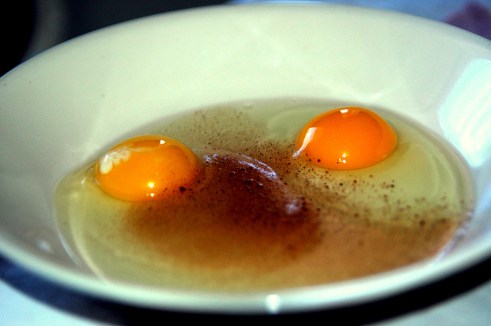
Here’s a recipe for my signature scrambled eggs with nutmeg and basil.
- 2 eggs
- 1 tbsp water
- 1 tbsp whole milk
- 1 tsp each dried basil, oregano, cilantro, and nutmeg
- salt and pepper to taste
Scramble all ingredients together with a fork. Stir constantly while cooking in a skillet if you want to get a fluffy, creamy cloud of eggs.
Mangiare Bene
It was almost midnight on a Friday evening. Dallas and I walked into our host family’s house after a night out in Florence (like two Cinderellas, we had to rush to make the last bus home, which left before anything really got started in the city.)
Our host dad greeted us: “Come avete mangiato?”
This exchange explains a lot of what I love about Italian culture. It’s always all about the food. No matter where you go, or what you do, an Italian will need to know “How did you eat?”
Not “How was the food?” which is what you might hear in America. “Oh, it was good, or it was great, or that cheesecake totally knocked my socks off,” you might respond to that American question.
The Italian question is actually so different, and it’s not just a matter of grammar. “How did you eat” encompasses the whole experience of a meal, from aperitivi to antipasti to primo to secondo to contorni to dolce to frutta to vino to caffe. The meal is never boiled down to its individual components, but taken holistically, experientially. “How was your experience of eating that meal?”
Dallas and I almost always answered his question, “Abbiamo mangiato molto bene!”—We ate very well! Because we almost always did.
Which brings me to another reason I love Italian culture: the concept of “eating well.” It’s not related to eating heathy (that’s “mangiare sano”) or eating locally (that’s a give-in) or eating organically (why do we Americans let politics suck all the joy out of the elemental physical pleasure of consuming our nutrients?)
It’s about the way the wine complemented the meat, the way that the sugo clung to the pappardelle, the way that the hostess took care of you and encouraged you to eat as much as you possibly could, the way that the conversation engaged you from the first bite of tortellini in brodo until the last sip of espresso.
Studies have shown that eating pasta improves your mood, my host dad often said in between primo and secondo, and this is what mangiare bene is all about: the feeling that you get when you know that every detail of a meal was perfect, every transition was as smoothly performed as though it were choreographed.
One scene of a play is not enough to make it a positive experience; the audience has to be connected to the plot, to the actors, to the characters. If someone asks you, did you enjoy that play, your response will not be, “Yes, Act III scene ii was just to die for.” Either the play captured you, or it did not.
The Italian meal is a complex performance, and the diner is a peculiarly involved member of the audience, contributing to the performance while also witnessing the drama of flavors mingling in the most private of theaters.
This is the beauty of Italian food culture. This is the reason Italians are not fat.
Zuppa di Ceci
During my last few months in Italy, I ate several times at Trattoria di Mario, a delightfully cramped lunch spot near the San Lorenzo market in the center of Florence.

At the Trattoria di Mario
This family-run eatery was memorable for its no-nonsense approach to customer service (si fa la bistecca come ci pare, we’ll cook the steak as we like–so don’t make any suggestions), 100% fresh ingredients, and a limited menu updated daily.
At its tiny, rustic wooden tables, I studied plackards on the wall with presumably witty sayings written in Florentine dialect, incomprehensible to me. I ate coniglio al rosmarino, bistecca alla fiorentina, and the most luscious french fries imaginable.
But I’ll never forget the zuppa di ceci (chickpea soup.) It was the dish that brought me back.

Mario's Zuppa di Ceci
The soup was so firmly lodged in my imagination that only a few weeks after my return to the States, I dreamed of eating it one night. The dream was vivid enough that I had no choice other than to find a recipe and attempt to replicate the experience here on American soil.
A Google search revealed this recipe from a blog called Ciao Chow Linda. As with my favorite Italian dishes, zuppa di ceci requires just a few ingredients and is incredibly simple to prepare. It’s representative of the concept of cucina povera, or the “poor kitchen”: making use of seasonal, inexpensive ingredients in elemental combinations to produce mindblowing flavors.
Ciao Chow Linda’s Zuppa di Ceci
For four people:
1 3/4 cups (400 grams) dried chick peas, soaked in about 6 cups water
2/3 of a small sprig of rosemary, minced, plus more for decoration
2 cloves of garlic
salt and freshly ground pepper
1 T. extra virgin olive oilSoak the chick peas in water for about 24 hours with a pinch of salt.
Cook them without salt for one hour in a pressure cooker, or two hours in a regular pot. (I added a parmesan rind to the pot)
Take out half of the chick peas and set aside. Puree the other half, then add the whole chickpeas to the pureed mixture.
Sauté the garlic and rosemary for a short time in a pan with the olive oil, until the garlic is barely golden. Add the garlic and rosemary to the cooked chick peas, cooking them together for a few minutes, to blend the flavors. Ladle in extra water to thin the soup to the density desired. Adjust seasonings, adding salt as required.
Optional: use vegetable broth instead of water to thin the soup.
Before serving, drizzle with a good extra virgin olive oil and grind some fresh black pepper on top. Add some hot red pepper flakes if you like more heat.
Il Bagno = WC (water closet)
On the drive back home after a Thanksgiving spent with family in upstate NY, my parents and I stopped at a farmstand to buy apples. I stopped in to use the bathroom. When I tried to lower the toilet seat, it came off in my hands, and this, of course, brought back memories of Italy.
Before I lived in Italy, I had no idea how many individual components there are to a satisfying public bathroom experience.
In America, my criteria were limited to available soap, toilet paper, and paper towels, and clean toilet seats. After a short amount of time in Italy, my personal list expanded to include:
- Is there a mirror?
- Is there a sink?
- Is there a toilet seat?
- Is there even a toilet? Or just a ceramic hole in the ground with helpfully indicated footholds?
- Is there a bathroom available to the public?
- Does the door lock?
- Does the door shut?
- Is warm water available?
- Along with the conventional soap, paper towels (not likely!), and toilet paper categories
If the answer to four or more of the above questions was yes, I deemed the venture a success, and added the bathroom to a mental map of superior facilities available in Florence.
Best bathroom award: on the train in Sicily from Agrigento to Siracusa, the bathroom drained onto the tracks. Looking down through the toilet, I could see th ground whizzing by below.
A sign in the stall read, “Do not use bathroom unless train is in motion.”
I’ll say.
Vino Nobile di Montepulciano

Per tutta la vita, ogni vino che bevi lo paragonerai a questo.
For the rest of your life, you will compare every wine you taste to this wine, my host father told me late one October evening.
The wine he referred to was Vino Nobile di Montepulciano, which we drank with each meal at his table. Its taste was crisp and clean. It warmed my throat with every sip.
One warm fall afternoon, my host parents took fellow host daughter Dallas and me with them to the tiny Tuscan hill town of Montepulciano and the Nobile vineyard located there. My host parents had been clients of this family for decades, travelling there several times each year to buy a supply of table wine, which they transported home in large glass jugs. At home, my host father had his own vacuum seal bottling machine, which he used to transfer the wine into smaller bottles for the table.
It was one of my first trips into the Tuscan countryside and I was awestruck by the views, the rolling hills, the golden vineyards, the way my stomach dropped when my host dad took narrow blind cliffside curves at harrowing speeds in his tiny sedan.
At the vineyard, my host parents were greeted as old family friends by the winemaker. While they exchanged news, I selected a wine to buy for myself. It was under ten euro, a very recent vintage.
I drank that bottle of wine a few nights ago. I always meant to open it sooner, but something in me held me back. It was the only bottle of wine I brought back to the states with me in January 2009, along with an embarrassingly large stash of chocolate. The chocolate is now long gone, thanks to a family of mice who nested in the walls around my dorm room last winter. But the wine remained, proof that the whole trip hadn’t been just a lovely but impossible dream.
With my January 3 ticket to Italy now booked, it felt finally right to open that bottle.
When the first sip of wine touched my tastebuds, it transported me back to the Italian kitchen in which I passed so many happy moments with a wonderful family.
It’s not only the taste of the wine that I’ll compare all future experiences against.
All-American Crepes
Gosh, it’s hard to have time for blogging when you are packing up the last 12 years of your life.
But there is always time to reminisce about warmer days…like the first few days in September, when I ate outside at a cafe with my parents in the town of Fairport, NY, where they are moving.

This is the all-American crepe: strawberries, blueberries, and vanilla ice cream from Simply Crepes in Fairport NY.
Here’s to sweet memories and a very joyful Thanksgiving!
Panettone is popping up everywhere

Panettone in a Florentine supermarket
Nothing says Christmas quite like the colorful boxes of panettone and pandoro that appear in supermarkets across America this time of year.
Both breads are high-rising and sweet–Italians eat them for dessert and for breakfast during the Christmas season. Panettone is studded with nuts and dried fruit, while Pandoro (litereally “golden bread”) is simply dusted with powdered sugar. Of course, variations are filled with chocolate or nutella for a truly decadent experience.
After Christmas, they go on sale for one or two euro each. When I lived in Italy, my friend Dallas and I planned a post-Christmas trip to Vienna and Prague. Before leaving Italy, we bought a panettone and it became the third member of our party. It accompanied us to museums, Christmas markets, and coffee shops.
Most memorably, it was the guest of honor at a New Year’s Eve party spent in a concentration camp-like hostel just far enough outside of Prague that it was reachable only by buses that ran only until 11pm. Other guests included Ritter chocolate bars and wafer cookies.
Thanks to Alan Richman, guest speaker at my food blogging class last night, for the suggestion to plagiarize myself because it’s so much easier than actually working. I grabbed this photo from a post in my old blog that I kept when I was actually in Italy.
Happily, I’ll be back in Italy in time to buy a few one euro loaves and get a little bit of that old sugar high.
I’m on craftgawker!
I am so excited that one of my photos from my most recent post, “Leaving,” is now a featured photo on craftgawker.com. I have long followed this website and used its links as a constant source of colorful inspiration and distraction–it’s like finding a little corner of a cozy cottage filled with homey arts & crafts on the web.

 When Nutmeg Met Basil
